

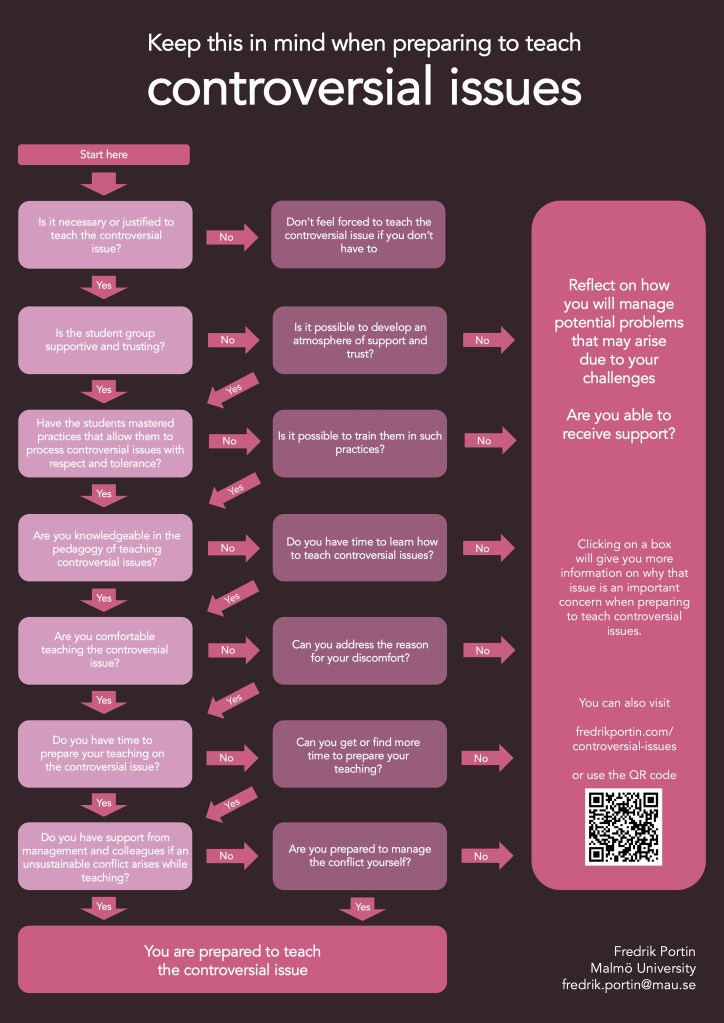
The tool aims to help educators prepare for teaching controversial issues. It highlights the most common pitfalls that teachers face when teaching controversial issues. By navigating from one question to another in the tool, teachers can see the challenges they face when teaching a specific issue.
The pdf file of the tool is interactive. When you click on one of the boxes, it takes you to a page that explains why that question is important to consider.
Click on the image to download the interactive tool
What is a controversial issue?
Controversial issues can be defined in different ways. One definition is that these are such issues or themes that have the potential for conflict between students or between student and educator. This means that they have a special character in teaching, as they can cause significant disagreements and arouse strong emotions.
What constitutes a controversial issue is determined on the basis of ethical, historical, social, political, and ethnic contexts and principles. Examples of controversial issues that are often mentioned in the research literature are the Israel-Palestine conflict, abortion, distribution of economic resources, racism, sexuality, gender, immigration, and religion. But there are far more.
Differences in what counts as controversial also vary by context (not all issues are controversial everywhere) and by time (some issues may be more or less controversial in different time periods).

Why was the tool created?
Since controversial issues can lead to significant disagreements, it is risky to address them in teaching. This risk is reinforced by the fact that many educators report receiving very little or no training in teaching controversial issues.
To assist educators in their work teaching about controversial issues, this tool highlights the challenges they often face.
Mind you: The purpose is not to get educators to avoid teaching controversial issues. On the contrary, there are good reasons why an educator chooses to do so. However, this type of teaching requires careful preparation, as it can have negative consequences if done incorrectly, with harmful polarization and polemics probably being the most problematic.
The purpose of the tool is to highlight the challenges educators may encounter when teaching controversial issues. If you use this map and reflect on all the points, you will thus be better equipped to meet students in your teaching.

It is not always possible to avoid teaching becoming controversial
Even if you don’t teach controversial issues or your subject area itself isn’t controversial, your teaching may still be controversial.
Every educator lives with the risk that controversy will suddenly arise in teaching, even if they did not think what was being discussed was controversial. For example, it may be that a student highlights something during a lecture that can be perceived as controversial, and that the educator then has to deal with. Or the educator says something that a certain group of students finds offensive, even though another group of students would not have perceived it in the same way.
It is difficult to prepare for such events. If they happen, you hope that you can get support from colleagues and management, especially if you feel that you cannot handle the situation yourself.
The tool is not designed for such situations. What you can do, however, is to use it in conversations with colleagues. Feel free to discuss the current controversial issues within the team that are relevant to your subject area and courses.
By discussing potential issues with the tool, you, as a collegiate team, can identify individual and collective challenges within the team when dealing with a particular controversial issue. In this way, the team can be prepared to handle it if it suddenly arises in class.
.

How do you use the tool?
The tool is quite intuitive. You start at ”Start here”. Then, answer yes or no to each question to see if you’ve identified your challenges when teaching a specific controversial issue. If you answer no, you will usually get a follow-up question.
If you manage to maneuver your way down to the last box, well, then you are prepared to teach about the controversial issue. However, if your answers lead you to the right box, you should reflect on how to address any issues that may arise from your challenges. Can you perhaps get help with your teaching?
Mind you: just because you get to the box on the right doesn’t mean you can’t or shouldn’t teach about a controversial issue. Sometimes it is even necessary to do so – perhaps because your subject requires you to address a particular issue, or because it is a current issue that students are demanding that you address. The purpose of the tool is only to highlight your challenges, not to prevent you from teaching about a controversial issue.
If you want to know more about why each question is important to consider when teaching controversial issues, click the box for that question in the PDF version of the tool. It will take you to a homepage with more information. The website also includes a short introductory video for each box, as well as references to the research literature.
Material
Hess, Diana E. Controversy in the classroom: The democratic power of discussion. The critical social thought series. New York: Routledge, 2009.
Misco, Thomas. ”The importance of context for teaching controversial issues in international settings”. International Education 42, 1 (Fall 2012): 69–84.
Papamichael, Elena, Mary Gannon, Bojka Djukanovic, Rosa Garvín Fernández, David Kerr, & Ted Huddleston. Living with Controversy: Teaching controversial issues through education for democratic citizenship and human rights: Training pack for teachers. Strasburg: Council of Europe, 2015.
Portin, Fredrik. ”The Paradox of Controversy: The Possibilities and Risks of Teaching Controversial Issues in Religious Education”. In Religious Literacy in Secular Religious Education: Nordic Perspectives and Beyond, edited by Daniel Enstedt, Karin Kittelmann Flensner, & Wilhelm Kardemark, 195–213. Religious Diversity and Education in Europe, volume 46. Münster New York: Waxmann, 2024.
Other
If you feel that this tool was helpful, please share it with your colleagues and others who could potentially use it.
For questions and comments, please contact Fredrik Portin, Malmö University (fredrik.portin@mau.se).

